
Falls are one of the most persistent safety challenges in nursing homes, skilled nursing facilities, long-term care facilities, and care homes. They are rarely caused by a single issue. A resident may fall because of weakness, medication side effects, poor lighting, cognitive impairment, urinary urgency, cognitive changes, unsafe footwear, poor transfer technique, or a missed care-plan update.
That is why fall prevention in nursing homes cannot be treated as a checklist task. It has to function as a complete, facility-wide program.
A strong fall prevention program in nursing homes brings together risk assessment, individualized care planning, environmental safety, staff communication, resident engagement, post-fall review, and consistent follow-through. The goal is not only to respond after a fall happens, but to reduce avoidable risk before it becomes an incident.
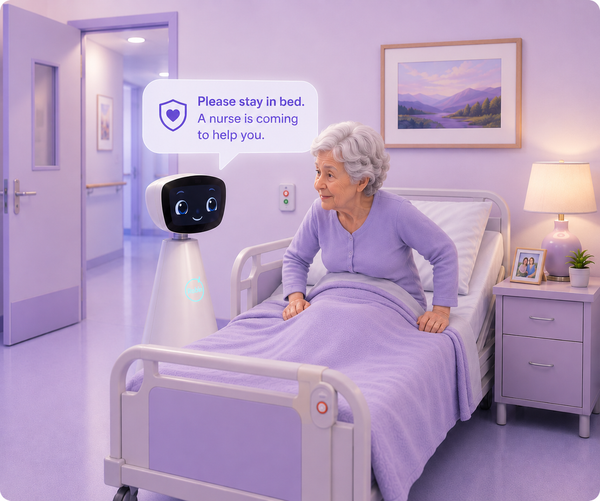
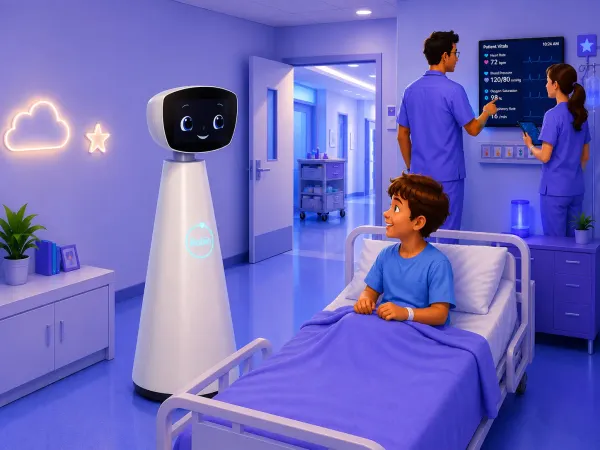
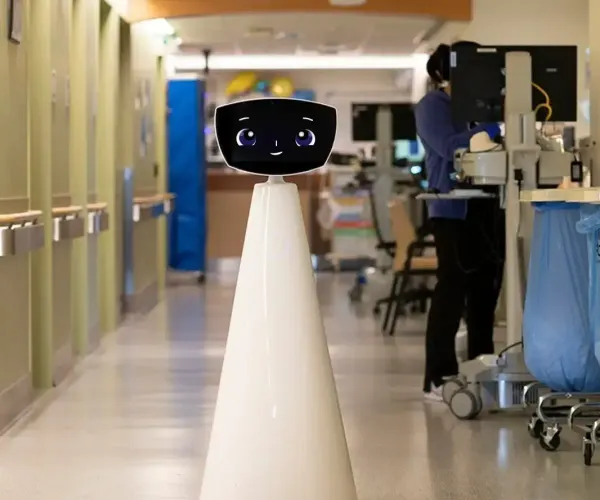
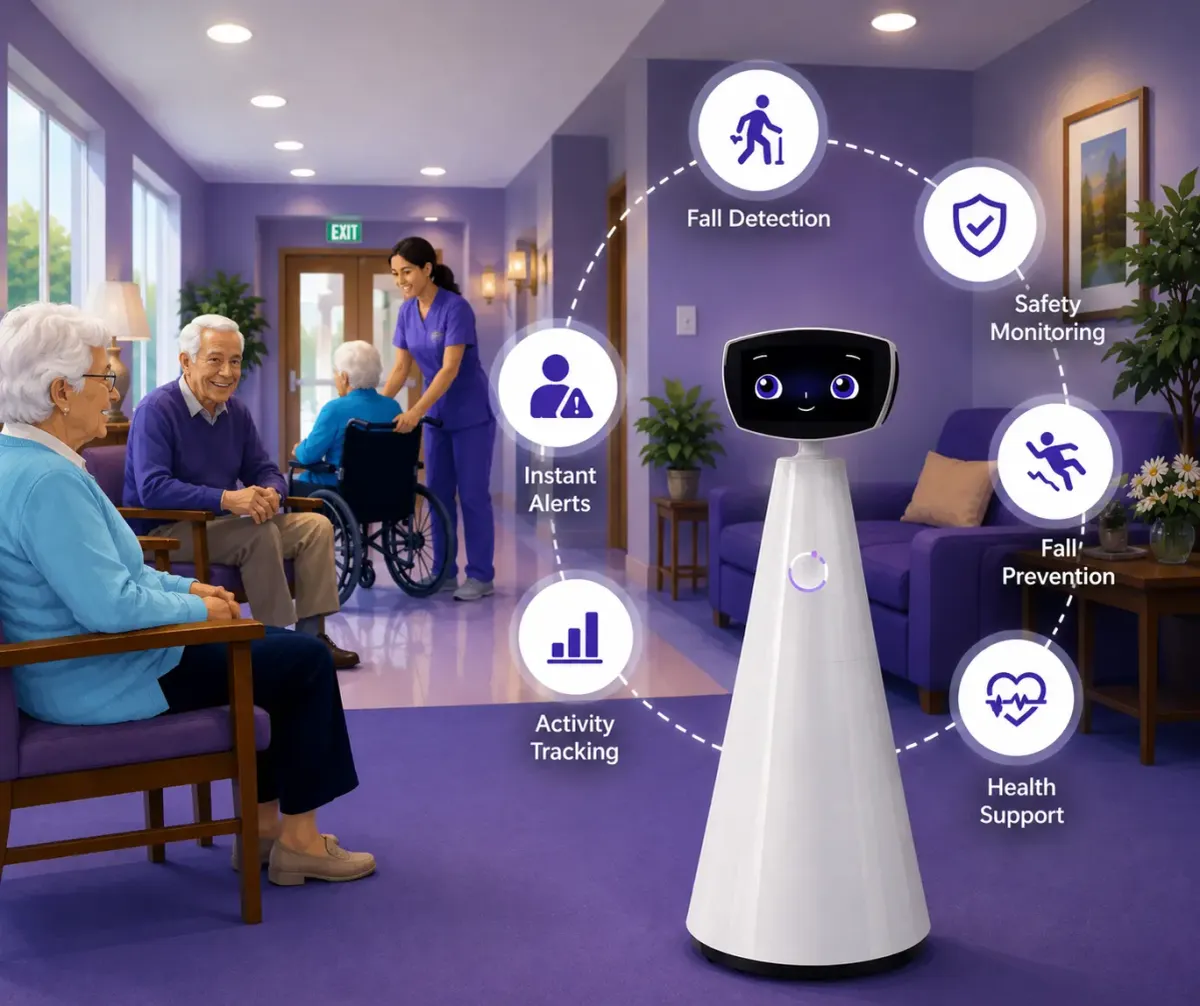
For healthcare teams evaluating the role of technology in this process, Robin Robot represents a different category of support than passive monitoring tools. Robin is a socially assistive robot designed to interact with residents, support staff workflows, and help create more consistent engagement in care environments. In fall prevention, that matters because many risks are behavioral and situational. A resident may know they should wait for help but forget, become anxious, or try to stand before staff can respond.
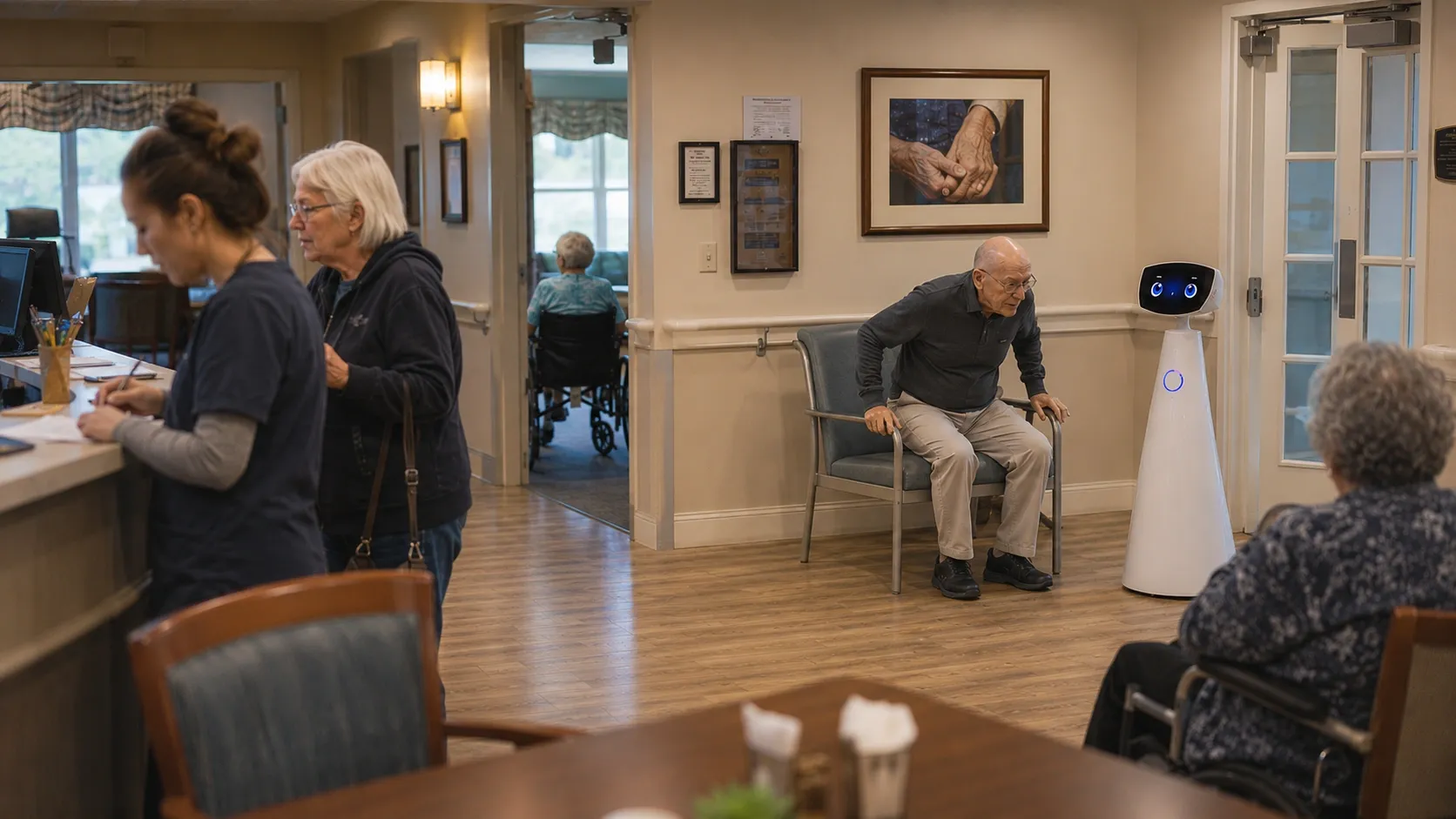
This is especially relevant in eldercare settings, where an elder care robot can support the human side of prevention: reminders, redirection, emotional engagement, routine reinforcement, and escalation support. It does not replace nurses, CNAs, therapists, or fall protocols. Its role is to strengthen the parts of care that are difficult to sustain manually across every resident, every shift, and every high-risk moment.
Why fall prevention matters in nursing homes
Falls are common among older adults, but the risk is higher in institutional care environments. The CDC reports that more than one out of four older adults falls each year, and falling once doubles the chance of falling again. Older CDC nursing-home data also notes that many nursing home residents fall each year, with some falls going unreported.
For nursing homes and long-term care facilities, falls create several overlapping risks:
- resident injury, pain, fear, and loss of independence
- hospital transfers and care disruption
- increased documentation and investigation workload
- family concern and reputational pressure
- regulatory scrutiny
- higher staff stress, especially during understaffed shifts
The issue is not that facilities lack policies. Most nursing homes already have fall precautions, incident reporting processes, care plans, and post-fall procedures. The weaker point is usually execution: making sure the right precautions happen at the right time, for the right resident, across every shift.
What is a fall prevention program in nursing homes?
A fall prevention program in nursing homes is a structured, multidisciplinary system for identifying residents at risk of falling, reducing modifiable risk factors, and improving the facility’s response after a fall occurs
A complete program usually includes:
- Fall risk screening and reassessment
- Individualized care planning
- Medication review
- Mobility and transfer support
- Environmental safety checks
- Toileting and continence planning
- Staff communication and documentation
- Resident and family education
- Post-fall response and root-cause review
- Ongoing monitoring and quality improvement
The Agency for Healthcare Research and Quality describes its Falls Management Program as an interdisciplinary quality-improvement initiative designed to help nursing facilities provide individualized, person-centered care and improve fall care processes and outcomes.
That distinction matters. Fall prevention is not only a nursing assessment. It is an operating system for safer care.
Common causes of falls in nursing home patients
Preventing falls in nursing home patients starts with understanding why residents fall. Most facilities already know the broad risk categories. Problems occur when those categories are not translated into daily care behaviors.
Intrinsic risk factors
Intrinsic factors come from the resident’s health status, cognition, mobility, and physical condition.
Common examples include:
- muscle weakness
- poor balance
- impaired gait
- dizziness or orthostatic hypotension
- dementia or confusion
- vision impairment
- pain
- incontinence or urinary urgency
- history of previous falls
- acute illness or infection
- fear of falling
A resident who forgets to call for help, tries to stand quickly, or becomes restless during certain times of day needs more than a generic “high fall risk” label. They need a care plan that reflects when, why, and how their risk appears.
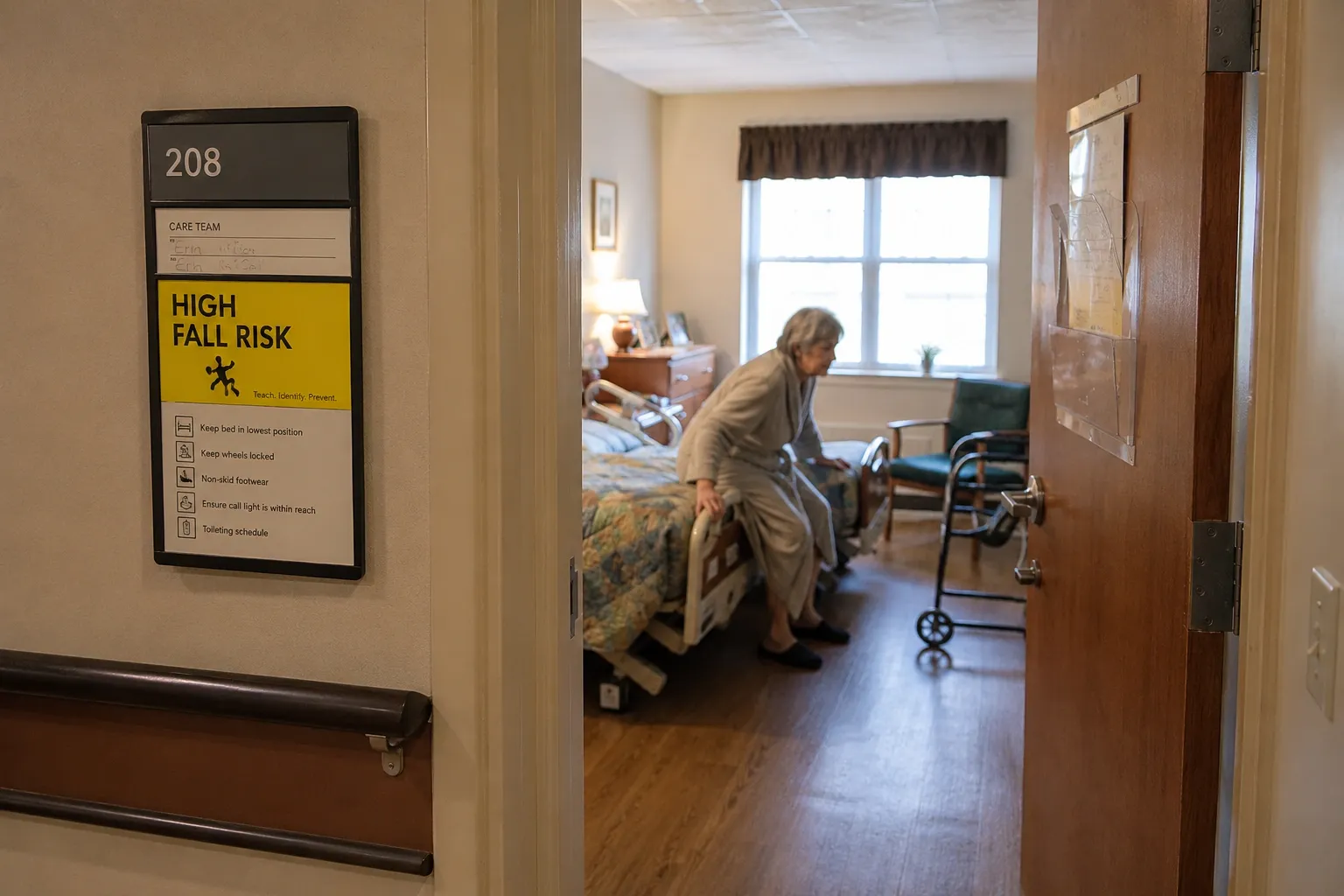
Medication-related risk factors
Medication review is one of the most important parts of reducing falls in nursing homes. Some medications can increase dizziness, sedation, confusion, or blood-pressure changes.
Examples include:
- sedatives
- antipsychotics
- antidepressants
- antihypertensives
- diuretics
- opioids
- sleep medications
- medications with anticholinergic effects
The issue is not simply whether a resident is taking a high-risk medication. The stronger question is whether the care team has reviewed timing, dose changes, side effects, interactions, and fall history together.
Environmental risk factors
Environmental hazards are easier to see, but they are also easy to miss during busy shifts.
Common risks include:
- poor lighting
- cluttered pathways
- wet floors
- loose cords
- unstable furniture
- poorly positioned call lights
- improper bed height
- missing grab bars
- unsafe footwear
- wheelchairs or walkers placed out of reach
Environmental safety should be built into rounding, room checks, admission workflows, and post-fall reviews. If it depends only on occasional audits, gaps will remain.
Situational risk factors
Many falls occur during predictable moments:
- getting out of bed
- transferring to a chair
- walking to the bathroom
- toileting
- bathing
- reaching for personal items
- standing after meals
- moving during periods of agitation or confusion
This is where fall prevention becomes practical. A facility may know a resident is at risk, but the program must also identify the specific situations where that risk becomes active.
Core components of a nursing home fall prevention program
1. Fall risk assessment
Risk assessment should begin at admission and continue whenever the resident’s condition changes. It should not be treated as paperwork that only satisfies compliance requirements.
A useful fall risk assessment considers:
- previous fall history
- mobility level
- assistive device use
- cognition
- continence
- medication profile
- vision and hearing
- pain
- footwear
- room setup
- transfer ability
- acute changes in condition
The assessment should lead directly to action. If a resident scores as high risk but the care plan does not change meaningfully, the assessment has limited value.
2. Individualized fall prevention care plans
A fall prevention care plan should be specific enough for staff to act on during real care.
Weak care-plan language sounds like this:
Monitor resident. Keep call light within reach. Use fall precautions.
Stronger care-plan language sounds like this:
Resident attempts independent transfers after dinner and during nighttime toileting. Offer toileting before bed and every two hours overnight. Keep walker on right side of bed. Use low bed setting. Provide verbal reminder before standing. Escalate increased restlessness to nurse.
The stronger version tells staff what to do, when to do it, and why it matters.
This is also where resident-level interventions become important. A facility may have a fall prevention policy, but the real reduction happens through specific actions tied to individual risk. The article on interventions to prevent falls in nursing homes goes deeper into practical prevention measures such as toileting schedules, mobility support, medication review, room setup, and resident-specific reminders.
3. Mobility, exercise, and transfer support
Fall prevention should not mean preventing movement. Over-restricting mobility can worsen weakness, reduce confidence, and increase dependence.
A balanced program supports safe movement through:
- physical therapy evaluation
- strength and balance exercises
- gait training
- proper use of walkers and canes
- transfer training
- wheelchair positioning
- restorative nursing programs
- safe footwear
- scheduled mobility support
The goal is safer function, not unnecessary immobility.
4. Toileting and continence planning
Toileting-related falls are common because residents may rush, feel embarrassed, or forget to ask for help. Residents with dementia may also be unable to explain urgency clearly.
Facilities can reduce risk by using:
- scheduled toileting
- prompted voiding
- bedside commodes when appropriate
- clear pathways to the bathroom
- night lighting
- call-bell reminders
- staff awareness of high-risk toileting times
This is one of the areas where consistent reminders matter. For appropriate residents, a socially assistive robot can reinforce prompts such as waiting for help, using the call bell, or staying seated until staff arrives.
5. Medication review
Medication review should involve nursing, pharmacy, and prescribing clinicians. It should be triggered by:
- admission
- a fall
- a near fall
- medication changes
- new dizziness or confusion
- increased sleepiness
- change in mobility
- change in blood pressure
A fall prevention program should not assume medication review is complete just because a list exists in the chart. The review must connect medication effects to the resident’s observed behavior and fall pattern.
6. Environmental safety
Environmental safety needs routine ownership. It should not be vague or left to “everyone.”
A room safety check should confirm:
- call light is reachable
- bed is at the correct height
- floor is dry
- pathway is clear
- walker or wheelchair is positioned correctly
- footwear is appropriate
- lighting is sufficient
- frequently used items are within reach
- cords and clutter are removed
- chair and bed alarms, if used, are functioning as intended
For care homes and long-term care facilities, this is one of the most direct ways to reduce avoidable risk. It is also one of the easiest areas for drift. What looks safe at 10 a.m. may not be safe at 10 p.m.
7. Staff communication across shifts
Many fall prevention failures happen during handoffs. A resident’s risk may be known by one nurse, one CNA, or one shift, but not consistently carried across the team.
Shift communication should include:
- recent falls or near falls
- behavior changes
- toileting patterns
- new medications
- changes in mobility
- new confusion or agitation
- family concerns
- equipment changes
- residents needing closer observation
The point is not to overload every handoff with generic fall-risk language. The point is to communicate the specific changes that affect what staff must do next.
8. Resident and family education
Education should be realistic. Some residents can understand and follow fall prevention instructions. Others may not remember them or may not have the cognitive ability to apply them consistently.
Education may include:
- asking for help before standing
- using assistive devices correctly
- wearing safe footwear
- moving slowly after sitting or lying down
- reporting dizziness or weakness
- keeping pathways clear
- understanding why certain precautions are in place
Families should also understand the facility’s approach. If they bring rugs, slippers, furniture, or personal items into the room, those choices can affect safety.
Fall precautions in nursing homes
Fall precautions are the daily actions that translate the fall prevention plan into practice.
Common precautions include:
- low bed positioning
- floor mats where appropriate
- call light within reach
- non-slip footwear
- safe room layout
- assistive devices nearby
- toileting schedule
- increased rounding
- supervision during transfers
- bed or chair alarms where appropriate
- clear signage or visual cues
- therapy referral
- medication review
- resident-specific reminders
The important point is that fall precautions should not be copied from one resident to another without clinical judgment. A resident with impulsive standing behavior needs different precautions from a resident who falls because of weakness during transfers.
What happens after a fall?
A fall prevention program is incomplete without a strong post-fall response.
After a fall, staff should follow the facility’s protocol for immediate assessment, injury evaluation, notification, documentation, and care-plan revision. The most useful post-fall reviews ask what changed and what can be corrected.
Key questions include:
- What was the resident trying to do?
- Where did the fall happen?
- What time did it happen?
- Was the resident alone?
- Was the call light reachable?
- Was the assistive device nearby?
- Were medications recently changed?
- Was the resident toileting, transferring, or reaching?
- Were there signs of pain, infection, dizziness, or confusion?
- Were existing precautions followed?
- Does the care plan need to change?
This is where protocols matter. A fall prevention program can identify risk, but the facility still needs a clear process for what staff should do after an incident. The article on nursing home falls protocol explains the post-fall workflow in more detail, including staff responsibilities, documentation, reassessment, escalation, and care-plan updates.
Technology’s role in reducing falls in nursing homes
Technology can support fall prevention, but it should not be presented as a stand-alone solution. Fall prevention in skilled nursing facilities and long-term care facilities still depends on clinical judgment, staffing, care planning, and resident-specific interventions.
Technology can help with:
- alerts
- monitoring
- documentation
- trend identification
- reminders
- engagement
- escalation
- workflow consistency
However, many technologies are reactive. They alert staff after a resident is already moving, already out of bed, or already at risk. That can help response time, but it does not fully address the behavioral and engagement side of prevention.
This is where socially assistive robotics can add a different layer of support.
Robin is designed to interact with residents in a human-centered way, helping create engagement, comfort, and repeated supportive prompts. In eldercare environments, that may include reminding appropriate residents to wait for help, supporting calmer routines, encouraging engagement, and helping staff maintain more consistent safety workflows.
The ACM/IEEE HRI 2026 paper “Generative Encounters with Robin: Design through Adaptation and Appropriation of a Social Robot in Four Eldercare Facilities” examined how caregivers and residents used Robin in real eldercare settings. Indiana University’s summary of the paper notes that it focused on how caregivers and residents “reinterpret and repurpose robotic systems in practice rather than using them exactly as designed.”
That point is highly relevant to fall prevention. In nursing homes, technology rarely succeeds only because of its technical features. It succeeds when staff can adapt it into daily workflows and residents respond to it as part of their care environment. In the Robin study, one staff member’s reaction captured that operational acceptance:
I think it’s doing an amazing job. I could give an employee of the month to Robin. The residents love Robin, the families love Robin. The employees love Robin.
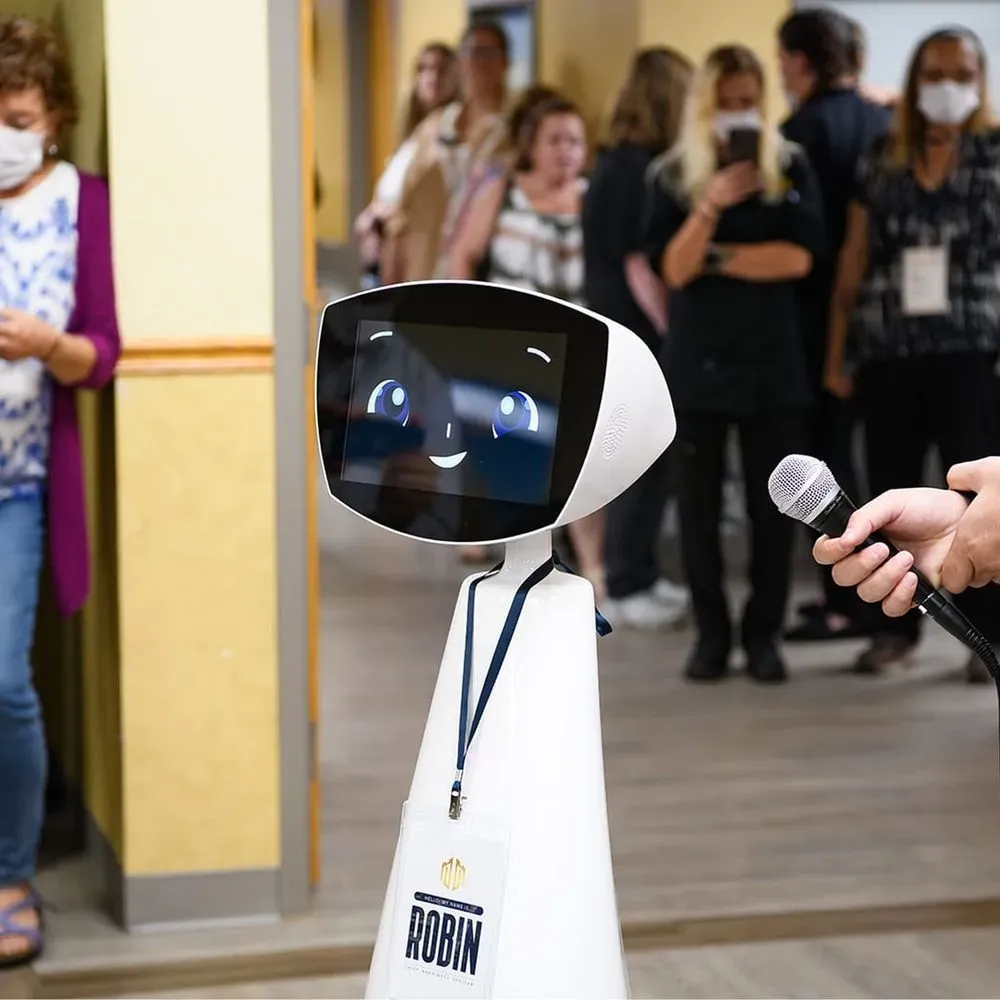
That quote should not be used to claim that Robin directly reduces falls by a specific percentage. The stronger and more defensible point is that Robin can become an accepted part of eldercare routines, which matters when prevention depends on repeated engagement, resident cooperation, and workflow consistency.
A related fall prevention case study shows how robotics can be positioned inside a broader fall prevention program rather than as a replacement for clinical protocols or staff supervision.
The staffing problem behind fall prevention
Many fall prevention plans look strong on paper but become fragile during busy shifts.
A resident may need redirection every time they try to stand. Another may need repeated reminders to use the call light. Another may become anxious, restless, or lonely, increasing unsafe movement. Staff may know exactly what should happen, but they may also be responsible for many residents at once.
This is why reducing falls in a care home is not only a clinical problem. It is also an operational consistency problem.
Common execution gaps include:
- delayed response to call lights
- missed rounding
- inconsistent reminders
- rushed handoffs
- incomplete documentation
- poor follow-through after care-plan changes
- overreliance on one-on-one sitters
- staff fatigue
- competing resident needs
Facilities often use one-on-one sitters for residents at high risk of falls, but sitter coverage can be expensive and difficult to sustain. The better question is not whether sitters are ever needed. Sometimes they are. The question is whether every resident currently receiving high-cost observation needs the same level of human-only monitoring at all times.
For facilities evaluating where sitter use is clinically necessary and where supportive workflows may reduce pressure, the article on reducing fall prevention sitter costs explains how alternatives to one-on-one sitters can fit into a broader safety strategy.
Building a complete fall prevention program
A complete program should connect policy, people, environment, and technology.
Step 1: Define program ownership
Fall prevention should have clear leadership. Depending on the facility, this may include:
- director of nursing
- administrator
- quality improvement lead
- rehabilitation team
- pharmacy consultant
- frontline nursing staff
- CNA representatives
- risk management
- medical director
If ownership is unclear, fall prevention becomes everyone’s responsibility in theory and no one’s responsibility in practice.
Step 2: Standardize risk assessment
Use a consistent process for identifying fall risk at:
- admission
- readmission
- quarterly reviews
- post-fall reviews
- medication changes
- changes in condition
- therapy status changes
- new cognitive or behavioral symptoms
Standardization helps ensure risk is not missed, but it should not replace clinical judgment.
Step 3: Individualize the care plan
Every high-risk resident should have specific interventions based on their actual fall pattern.
The care plan should answer:
- When is the resident most likely to fall?
- What are they usually trying to do?
- What support prevents that situation?
- What equipment is needed?
- What reminders are effective?
- What should staff escalate?
- How will the team know if the plan is working?
Generic fall precautions are not enough.
Step 4: Train staff on real scenarios
Training should not only explain policy. It should use actual resident scenarios.
For example:
- A resident with dementia stands repeatedly after dinner.
- A resident becomes dizzy after a medication change.
- A resident tries to toilet independently at night.
- A resident refuses to use a walker.
- A resident falls during transfers despite assistance.
Scenario-based training helps staff connect risk factors to action.
Step 5: Make rounding more purposeful
Rounding should not become a mechanical task. It should actively check the conditions that lead to falls.
Purposeful rounding may include:
- pain
- position
- personal items
- toileting
- mobility needs
- emotional state
- room safety
- reminders to call for help
For some residents, emotional state matters. Restlessness, anxiety, boredom, or loneliness can contribute to unsafe movement. Engagement is therefore not separate from fall prevention. For some residents, it is part of prevention.
Step 6: Review every fall for system gaps
Post-fall review should identify whether the fall was connected to:
- assessment gaps
- care-plan gaps
- communication gaps
- staffing gaps
- equipment gaps
- environmental gaps
- behavior changes
- medication changes
- delayed response
- resident non-adherence
- missing reminders
The goal is not blame. The goal is pattern recognition.
Step 7: Track outcomes and adjust
Facilities should monitor:
- total falls
- falls with injury
- repeat falls
- falls by unit
- falls by shift
- falls by location
- falls during toileting
- falls during transfers
- response times
- care-plan update completion
- sitter use
- hospital transfers after falls
Data should lead to action. If falls cluster during a certain shift, location, or activity, the program should change accordingly.
Fall prevention in long-term care facilities vs. skilled nursing facilities
The principles are similar, but the operational context differs.
Long-term care facilities
In long-term care, residents often stay for extended periods. The team has more opportunity to understand routines, behavior patterns, preferences, and triggers.
Fall prevention in long-term care facilities should focus heavily on:
- long-term behavior patterns
- chronic condition management
- dementia-related risk
- restorative mobility
- environmental consistency
- staff familiarity with residents
- ongoing care-plan refinement
Skilled nursing facilities
In skilled nursing facilities, residents may have shorter stays, higher acuity, and more frequent changes after hospitalization.
Fall prevention in skilled nursing facilities should emphasize:
- admission risk screening
- post-hospital weakness
- medication changes
- therapy coordination
- transfer safety
- rapid reassessment
- discharge planning
- communication between nursing and rehabilitation
Preventing falls in long-term care and skilled nursing requires the same discipline, but the timing and intensity of interventions may differ.
Common mistakes in nursing home fall prevention
Mistake 1: Treating fall risk as a static label
A resident’s fall risk changes. A medication change, infection, poor sleep, dehydration, pain, or cognitive decline can alter risk quickly.
Mistake 2: Using generic interventions
“Fall precautions in place” is not a plan. A useful plan specifies actions tied to resident behavior.
Mistake 3: Ignoring near falls
Near falls are warning signals. They should trigger review before an injury happens.
Mistake 4: Separating engagement from safety
Residents who are bored, anxious, confused, or restless may move unsafely. Engagement can be part of risk reduction.
Mistake 5: Overrelying on alerts
Alerts can help staff respond, but they do not automatically prevent risky behavior. Prevention also requires anticipation, redirection, and consistent support.
Mistake 6: Failing to close the loop after a fall
A post-fall form is not enough. The facility must update the care plan, communicate changes, and monitor whether the new interventions work.
Where Robin fits into fall prevention programs
Robin can support fall prevention programs by reinforcing parts of the workflow that depend on consistency, interaction, and resident engagement.
Potential support areas include:
- reminding appropriate residents to wait for assistance
- encouraging use of call lights or staff support
- helping reduce anxiety or agitation through interaction
- supporting engagement during high-risk periods
- reinforcing structured routines
- helping staff maintain more consistent resident-facing prompts
- supporting escalation workflows when integrated into facility processes
This is not a claim that Robin eliminates falls or replaces clinical protocols. More facility-specific outcomes research is needed to quantify fall reduction numbers. The stronger and more accurate claim is that Robin can help support the behavioral and workflow side of fall prevention, especially where repeated reminders, engagement, and staff consistency matter.
That distinction is important for credibility. A nursing home fall prevention program should not depend on technology alone. It should use technology where it strengthens the existing system: reinforcing reminders, supporting staff workflows, improving consistency, and helping residents stay engaged with care routines.
Conclusion: Fall prevention requires a program, not a policy
Fall prevention in nursing homes works best when it is treated as a complete program: risk assessment, individualized care planning, environmental safety, staff communication, post-fall review, resident engagement, and continuous improvement.
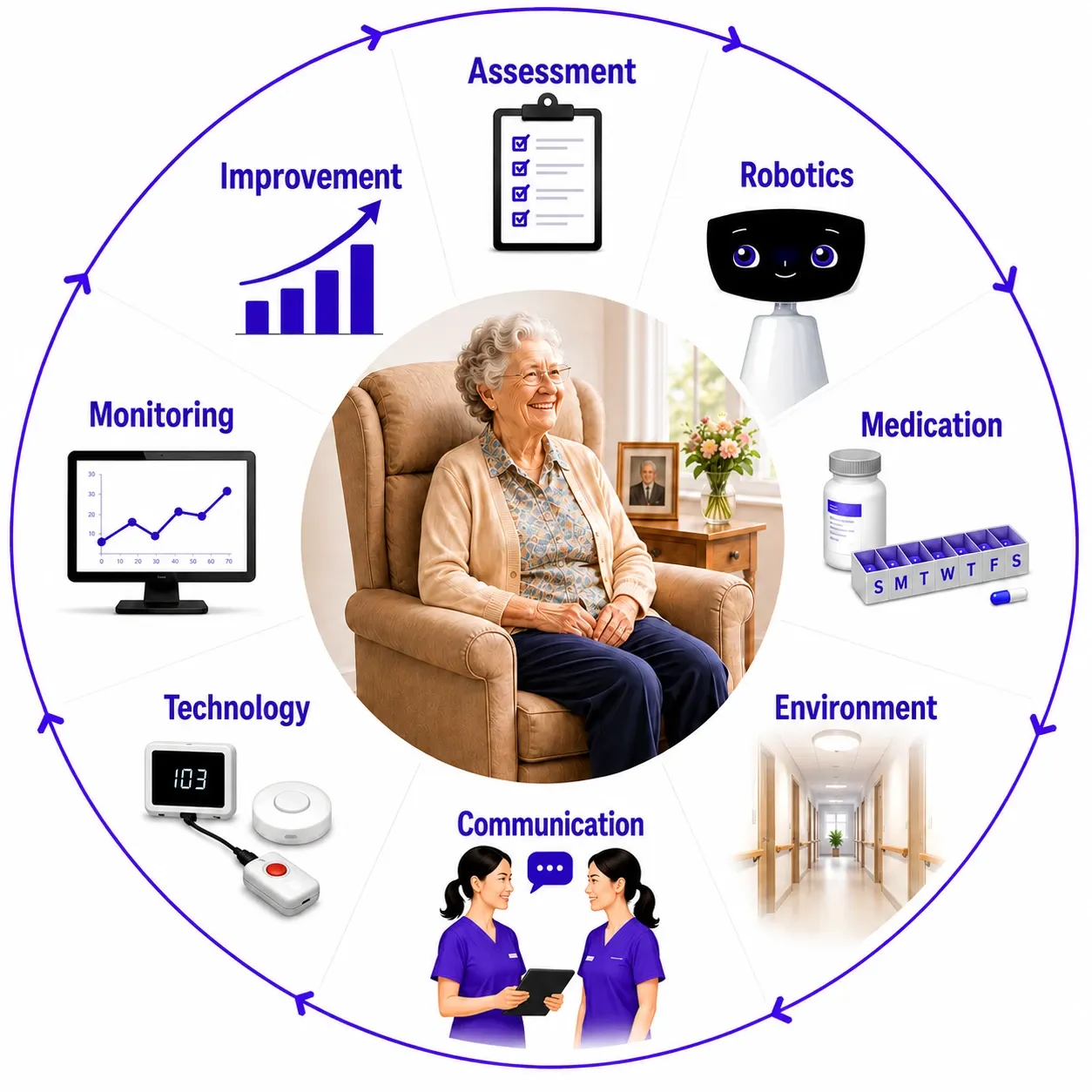
The same logic applies to fall prevention in long term care facilities, fall prevention in skilled nursing facilities, and falls prevention in care homes. The setting may differ, but the operational challenge is the same: facilities need consistent execution across residents, shifts, and changing risk conditions.
Policies define what should happen. Programs make it happen repeatedly.
That is also where many fall prevention efforts become vulnerable. A protocol may clearly state that a resident should wait for help, use the call bell, follow a toileting schedule, or receive frequent redirection. But if execution depends entirely on busy staff being available at every high-risk moment, the system can still break down.
Technology should not be presented as a shortcut around staffing, clinical judgment, or individualized care planning. The stronger position is more practical: technology can help reinforce the parts of fall prevention that are difficult to sustain manually, especially repeated reminders, resident engagement, workflow consistency, and escalation support.
For nursing homes and long-term care facilities, the future of fall prevention is unlikely to come from one intervention alone. It will come from better-designed programs where clinical protocols, staff workflows, environmental safety, resident engagement, and supportive technology work together.